
Construction Debris Removal in Houston: What Gets Refused, and What a Load Actually Costs
Published August 3, 2026 · By Daw's Junk Solutions
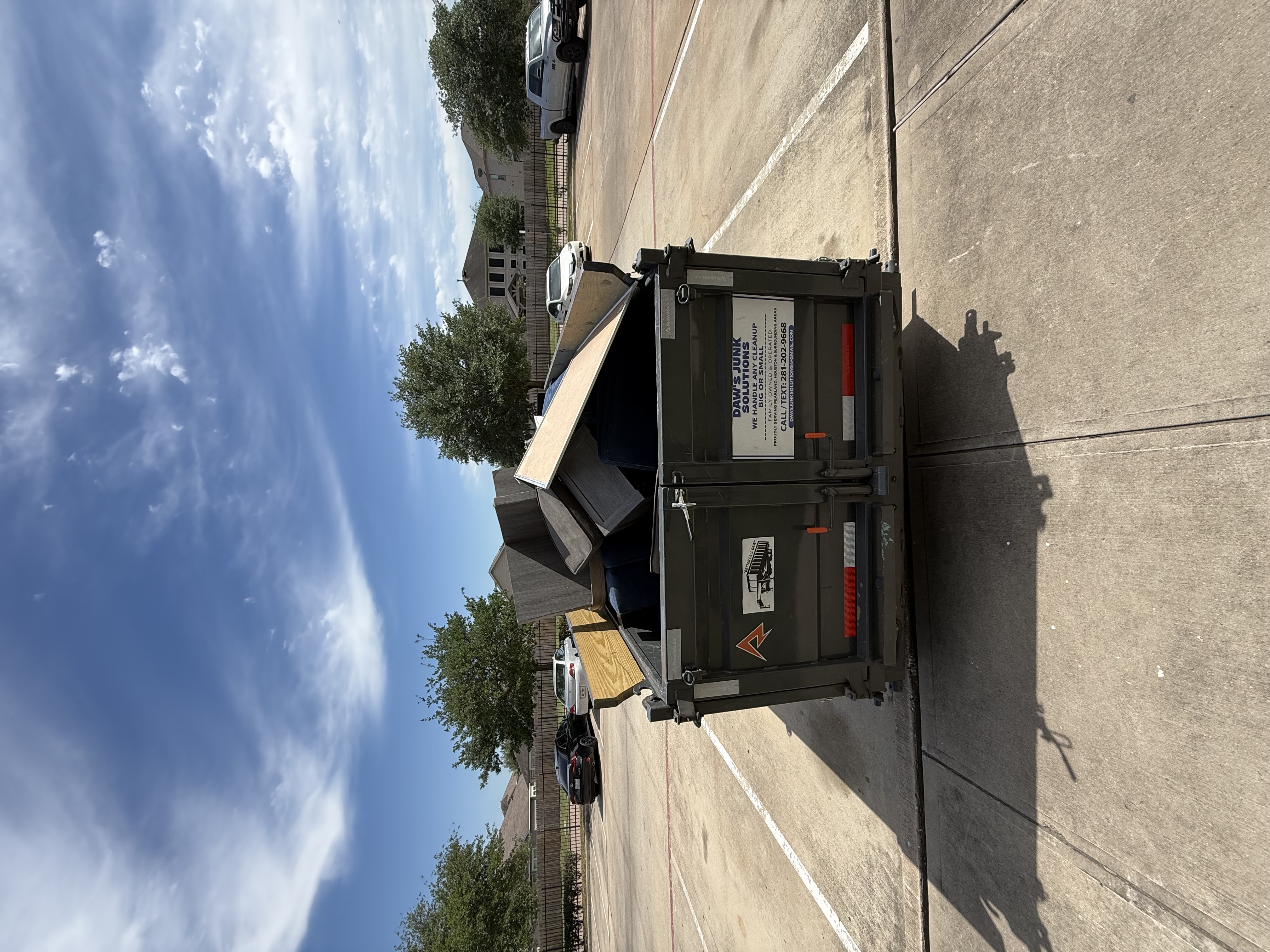
The pile is in the driveway. It has drywall in it, a stack of tearout cabinets, half a bathroom's worth of tile, and whatever the framers left behind. Electrical is scheduled Thursday and they cannot get to the panel wall until the pile moves. Every day it sits there, the whole schedule sits with it.
Most junk removal pages will tell you they haul construction debris and leave it at that. That is not useful when you are the one holding the schedule. The three things that actually decide how this goes are what the disposal site will refuse, what makes a load cost more than you guessed, and what the rule is on that older building you are about to open up.
Here is all three, straight, with the sources named so you can check them yourself.
What Loads Without a Conversation
The ordinary output of a remodel or a light demo. If it came out of the building and it is dry, it goes:
- Drywall and sheetrock scrap, including the tearout with paper and paint on it
- Framing lumber, cutoffs, plywood, OSB, and trim
- Doors, windows, cabinets, countertops, and old fixtures
- Tile, ceramic, hardwood, laminate, carpet and pad
- Roofing shingles and felt off a tearoff
- Insulation, batts, and torn-out ductwork
- Siding, soffit, fascia, and fence panels
- Pipe, conduit, wire, metal studs, and scrap metal
- Broken masonry and concrete chunks, in reasonable pieces
The full list of what we handle on a job site lives on our construction debris page, and mixed piles that are half debris and half everything else are just ordinary junk removal to us. One trailer, one trip, one price.
The one size limit worth knowing up front: a full slab, a poured foundation section, or a piece of concrete that takes equipment to move is not a job for a dump trailer. We will tell you that on the phone rather than after we have burned an hour of your day.
Pile holding up the next trade?
Send a photo, get a number, keep the schedule.
What Gets Refused, and Why It Is Not Up to Us
This is the part nobody puts on a junk removal page, and it is the part that costs a contractor a morning. When a load gets turned away, it does not get turned away at your gate. It gets turned away at the scale, with the material already loaded.
Start with where the material goes. Texas does not have one kind of landfill. TCEQ's own page on municipal solid waste landfills puts it plainly: MSW landfill facilities in Texas may consist of Type I landfill units for disposal of all types of municipal solid waste, or Type IV landfill units for disposal limited to brush, construction and demolition waste, and rubbish. A facility can contain both kinds of units. So your clean C&D load has more places it can go than a mixed load does, and a load that picks up household garbage on the way out of a remodel has fewer.
Then there is the flat prohibition list. TCEQ's Special Waste Disposal page lists what is prohibited from disposal in any MSW facility under 30 TAC 330.15(e):
- Lead-acid storage batteries
- Do-it-yourself used motor vehicle oil, and used oil filters from internal combustion engines
- Whole used or scrap tires
- Refrigerators, freezers, air conditioners, and other items containing CFC
- Bulk or noncontainerized liquid waste
- Wastes containing free liquids
- Regulated hazardous waste
- PCB wastes
- Radioactive materials
Read that list against a real job site and you can see where the trouble comes from. The paint the painter left. The five-gallon bucket with an inch of thinner still in it. The window unit the homeowner pulled out of the back bedroom and threw on the pile while nobody was looking. The tires that have been behind the garage since before you got the contract. None of that is exotic. It is just what accumulates.
TCEQ also treats a second group as special waste, meaning waste that requires special handling, trained people, or special disposal methods. Discarded materials containing asbestos are on that list, along with pesticide containers, contaminated soils, and incinerator ash. Special waste is not the same thing as prohibited waste, but it is not something a dump trailer takes on a Tuesday either.
Separate it before we get there and the whole day gets shorter
Liquids in one corner, batteries and tires in another, anything with refrigerant in it flagged. Those go to a household hazardous waste site or a certified recycler, not on our trailer. Everything else loads clean and we are gone.
You can read both TCEQ pages yourself: Type I and Type IV landfills and Special Waste Disposal. They are short and they are the actual rule, not somebody's blog summary of it.
The Older Building You Are About to Open Up
Almost nobody answers this one for Houston, so here it is with the citation attached.
The federal asbestos rule is the National Emission Standard for Asbestos at 40 CFR Part 61, Subpart M. The section that covers your job is 61.145, Standard for demolition and renovation. Its first sentence sets the obligation, and it is an obligation that runs before work starts, not after: to determine which requirements apply, and prior to the commencement of the demolition or renovation, thoroughly inspect the affected facility or part of the facility where the work will occur for the presence of asbestos, including Category I and Category II nonfriable asbestos-containing material.
Four things about that rule are worth having straight, because the version that gets repeated on job sites is usually wrong in at least one of them.
There is no building-age cutoff in the section
You will hear a year quoted, usually somewhere around 1980. That year is not in 61.145. The rule does not turn on when the building went up. The inspection requirement is written against the demolition or renovation activity itself, and what the requirements are after that turns on how much regulated asbestos-containing material is involved.
The amounts that trigger the rest of it are written down
61.145(a) sets the same numbers for demolition and for renovation. The full requirements apply if the combined amount of regulated asbestos-containing material is at least 80 linear meters, which the rule itself gives as 260 linear feet, on pipes; or at least 15 square meters, given as 160 square feet, on other facility components; or at least 1 cubic meter, given as 35 cubic feet, off facility components where the length or area could not be measured. Below those amounts on a demolition, the rule still pulls in a subset of the notification requirements.
Notice is measured in working days, in advance
Where notification applies, 61.145(b)(3)(i) says to postmark or deliver the notice at least 10 working days before asbestos stripping or removal work, or any other activity that would break up, dislodge, or similarly disturb asbestos material, begins. Ten working days is two calendar weeks on a normal schedule. That is a lead time you have to plan around, not paperwork you file on the way out.
Who is on the hook is defined broadly
Subpart M defines the owner or operator of a demolition or renovation activity as any person who owns, leases, operates, controls, or supervises the facility being demolished or renovated, or any person who owns, leases, operates, controls, or supervises the demolition or renovation operation, or both. Read that twice. It is written to cover the property owner and the contractor running the work, not one or the other.
One more piece of the definition matters on residential work. The same subpart defines facility to include institutional, commercial, public, industrial, and residential structures, but it excludes residential buildings having four or fewer dwelling units. A single-family house sits outside that definition. A twelve-unit apartment building does not. That distinction is doing a lot of work on any given job, and getting it wrong in either direction is expensive.
This is not legal or regulatory advice, and this is a limit, not a negotiation.
We are a hauling company. We are not an abatement contractor and we do not perform asbestos abatement, lead remediation, or any hazardous material work. We will not load asbestos-containing material, lead paint debris, or hazardous waste, at any price, on any schedule. For your specific building, talk to a licensed asbestos consultant or to TCEQ. On the state side, TCEQ points asbestos abatement and handling questions to the Texas Department of State Health Services Asbestos Program.
The rule text is public. You can read 40 CFR Part 61 Subpart M on eCFR and check every number above against 61.141 and 61.145 in about five minutes. Do that before the first day of demo, not after.
Clean debris, ready to go?
Same-day and next-day slots across the south suburbs.
What It Costs, by Load
We price by how much room the debris takes in the trailer. You get the number before anything is loaded.
- Minimum pickup, a few pieces: starting at $125
- Small load, about 2.25 cubic yards: starting at $175
- Medium load, 4.5 cubic yards or half the trailer: starting at $225
- Large load, about 6.75 cubic yards: starting at $325
- Full trailer load, 9 cubic yards: starting at $449
Be clear on this one, because it matters more on a job site than anywhere else: $449 is the price of one full trailer load. It is not a cap on the job. A single bathroom gut might be one load. An interior demo on a whole house is several, and each one is priced as its own load. Anybody quoting you a flat number for a gut without seeing it is either guessing or planning to renegotiate later.
The other thing to know is about weight, and this is a fact about the material rather than a line on a rate sheet. Dense debris runs out of weight before it runs out of volume. Concrete, brick, mortar, tile, dirt, and anything that has been sitting in the rain are heavy for the space they occupy. A full load of that material does not look full. The walls of the trailer are still showing and the load is done. That is not us shorting you, it is the trailer being at its limit. Tell us the material when you call and we will tell you what to expect before we roll, and the number gets confirmed on site.
For the full ladder and how we size a load, see the pricing guide.
Hauling Versus Renting a Dumpster, Argued Honestly
A dumpster is a good product. We are not going to pretend otherwise. The question is which one fits the job you are running this month.
The real difference is not the price. It is labor and it is the calendar. A dumpster arrives empty. Your crew fills it, on your clock, at your labor rate, carrying material out of the building and heaving it over the side. Then it sits in the driveway or a parking space until the hauler comes back for it, which is usually a scheduled day rather than the day you finished with it. On a tight lot, on a corner, or anywhere with an HOA or a permit for street placement, that parked box is its own problem.
When we come out, two guys carry it out of the building and load it. Your crew keeps working. The trailer leaves with the debris in it the same visit, and the driveway is clear when we pull out. No container sitting on the job, nothing for the next trade to work around.
When the dumpster is the better call
Plainly: if you are generating debris continuously for a week or more and you have laborers on site anyway with time in their day, a container that lives on the job is probably the right tool. Same answer if the material is coming out in a slow trickle over a long build and nobody needs the driveway. And if the volume is genuinely large and steady, a roll-off you fill yourself will usually beat paying for load-out labor you do not need.
We are the better call when the debris is already piled and in the way, when it is a one-time tearout, when there is no room for a container, when the schedule is the constraint, or when the crew you have is skilled labor you do not want moving drywall scrap by hand. Plenty of contractors use both, a container for the long stretch and us for the spikes. We wrote a longer comparison in junk removal versus dumpster rental.
Working a demo this week?
Give us the schedule and we will book against it.
Recurring Pickups and Staging Around Your Trades
One pile is a job. A build is a rhythm, and the rhythm is predictable if you have run enough of them.
Demo week throws off the biggest volume and the heaviest material. Rough in throws off cutoffs, boxes, and packaging. Drywall throws off scrap and the dust nobody wants tracked through a finished floor. Punch list throws off a little of everything plus the stuff that has been quietly stacking in the garage since week one. Four different piles, four different weeks, each one blocking somebody.
Give us the schedule at the start and we will put the pickups on the calendar against it. Standing weekly, or the day before each trade comes in, whichever matches how you run. You are not calling us in a panic on a Thursday morning, and we are not fitting you in between two residential jobs. That is how our commercial and job site accounts work, and it is the same crew and the same trailer either way.
A few things that make a job site pickup go fast, from doing plenty of them:
- Stage the debris in one spot the trailer can back to
- Keep liquids, batteries, tires, and anything with refrigerant out of the pile
- Tell us if it is heavy material before we come, not when we get there
- Say whether there is a gate code, a lockbox, or a super we check in with
- Flag low limbs, soft ground, and anywhere we cannot put the trailer
- Send a photo of the pile with a person or a door in frame for scale
Downtime costs more than the haul
A crew standing around waiting on a driveway to clear is the most expensive thing on the job that day. Book the pickup for the morning before the next trade, not the morning of.
We run this work out of Pearland and cover Friendswood, Alvin, Manvel, League City, Missouri City, Pasadena, Sugar Land, and the rest of the south side. Seven days a week, because job sites do not stop on Saturday.
Frequently Asked Questions
What construction debris will you take off a job site?
Drywall and sheetrock scrap, framing lumber and cutoffs, plywood and OSB, trim, doors, windows, cabinets, countertops, tile and flooring, carpet and pad, roofing shingles and felt, insulation, siding, pipe, conduit, wire, metal studs, broken masonry, and the general pile that builds up around a remodel. If it came out of the building and it is dry, it usually loads.
What will a Texas landfill refuse?
TCEQ lists wastes that are prohibited from disposal at any municipal solid waste facility under 30 TAC 330.15(e). The list includes lead-acid storage batteries, do-it-yourself used motor vehicle oil, used oil filters, whole used or scrap tires, refrigerators and freezers and air conditioners and other items containing CFC, bulk or noncontainerized liquid waste, wastes containing free liquids, regulated hazardous waste, PCB wastes, and radioactive materials. TCEQ separately treats discarded materials containing asbestos as special waste. We do not load any of it, and we cannot make an exception, because the disposal site is the one saying no.
Do I have to do anything before demo starts on an older building?
Under the federal asbestos NESHAP at 40 CFR 61.145(a), before a demolition or renovation begins you have to thoroughly inspect the affected facility, or the part of it where the work will happen, for the presence of asbestos. If the job crosses the amounts in the rule, written notice has to be postmarked or delivered at least 10 working days ahead. There is no building-age cutoff written into that section. This is not legal or regulatory advice, and your job is not our call. Talk to a licensed asbestos consultant or to TCEQ before you swing anything.
How much does construction debris removal cost?
We price by how much room the debris takes in the trailer. A minimum pickup starts at $125, a small load starts at $175, a medium load starts at $225, a large load starts at $325, and a full trailer load of 9 cubic yards starts at $449. That $449 is the price of one full trailer load, not a cap on the job. A gut of a single bathroom might be one load. A whole-house interior demo is several, priced load by load.
Why does a load of concrete look half empty?
Because dense material runs out of weight before it runs out of volume. Concrete, brick, mortar, tile, dirt, and rain-soaked debris are heavy for the space they take, so a load of that material hits the trailer's limit while the walls still look low. It is not a trick and it is not a different rate sheet. Tell us what the material is when you call and we will tell you what to expect on site.
Can you come back through the same job more than once?
That is most of what we do for contractors. Demo week, rough-in, drywall, punch list, each one throws off its own pile. Give us the schedule and we will book the pickups against it instead of waiting for somebody to call in a panic the day the flooring crew arrives.
Get the Pile Gone and Keep the Schedule
Call or text 281-202-9668 with the address, a photo of the pile, and what the material is. You get a price before we load, a crew that carries it out of the building, and a clear driveway when we pull out. If you are running more than one job, ask about standing pickups. Better Call Daw.