
Storage Unit Cleanouts in Houston, and What Texas Lien Law Actually Says
Published August 3, 2026 · By Daw's Junk Solutions
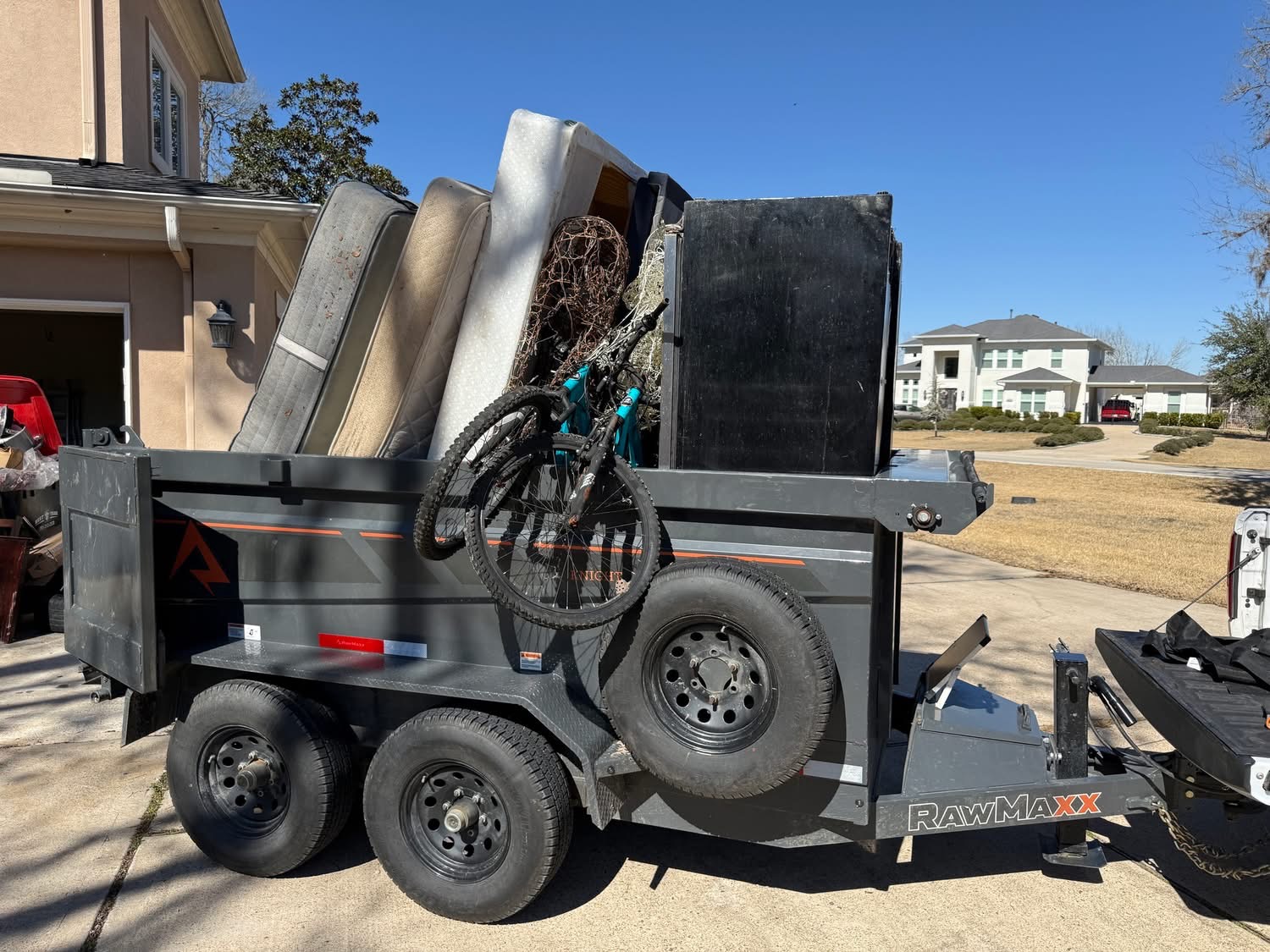
There are two people reading this. One has been paying somewhere between $80 and $200 a month for a unit they have not opened in a year or three, and they have finally had enough of the autopay hitting. The other opened an envelope or an email from the facility with the word lien in it and is now on a clock they did not choose. Different problems, same fix at the end, so this covers both.
If you are the second person, the timeline is right below this paragraph instead of eight hundred words down the page. Nobody is going to lecture you about how it got here first. Units fill up after a death, a divorce, a move that fell through, a job that ended, or a plan that made sense at the time and then quietly stopped making sense. That is most of the calls we get.
If you are already on a deadline
Call or text 281-202-9668 and say you have a lien notice and a date. We will work the schedule around the date. Say the unit size and the facility and we can usually tell you on that call whether it is one load or more.
What Texas Law Actually Requires Before a Facility Can Sell Your Things
Self-service storage liens in Texas are governed by Chapter 59 of the Texas Property Code. It is short, it is public, and almost nobody quotes it to you. Everything in this section comes from the text of the chapter, with the section numbers so you can check it yourself.
Plain note before we start
This is general information about Texas law. It is not legal advice, and we are a hauling company, not a law firm. Your rental agreement and your facility control the specifics of your situation. If real money or irreplaceable property is on the line, talk to a lawyer.
The lien exists from day one
Section 59.021 is one sentence: "A lessor has a lien on all property in a self-service storage facility for the payment of charges that are due and unpaid by the tenant." Section 59.006 adds that the lien attaches on the date the tenant places the property at the facility, and that it takes priority over all other liens on the same property. The lien is not something the facility creates when you fall behind. It has been there since the day you carried the first box in.
Whether they need a judge depends on your contract
Section 59.041(a) says a facility may enforce the lien only under a judgment from a court that forecloses the lien and orders the sale. Subsection (b) is the exception that swallows the rule in practice: they can seize and sell without a court if the seizure and sale are made under the terms of a contractual landlord's lien "as underlined or printed in conspicuous bold print in a written rental agreement," and are made in accordance with the chapter. Nearly every storage contract in Texas has that bold paragraph. If you want to know which path applies to you, go find your rental agreement and look for it.
The 14 days start when the notice goes out, not when you miss a payment
This is the part that gets stated wrong most often, and it is the part that costs people days. Section 59.042(a) requires the facility to deliver written notice of the claim to the tenant. Section 59.042(b) then says that if the tenant fails to satisfy the claim on or before the 14th day after the date the notice is delivered, the facility must publish or post notices advertising the sale.
Chapter 59 does not say how late you have to be before the facility is allowed to send that notice. That comes from your rental agreement, not the statute. The 14 day window is measured from delivery of the notice.
Delivery has a specific meaning here, and it is worth reading twice. Section 59.043(c) allows the notice in person, by email, or by verified mail to your last known email or postal address as stated in the rental agreement, and then says: "Notice by verified mail is considered delivered when the notice, properly addressed with postage prepaid, is deposited with the United States Postal Service or a common carrier." Deposited, not received. Section 59.001(5) defines verified mail as any method of mailing that provides evidence of mailing. So if it sat in a mailbox for four days, four of your days are gone. Email is only allowed under Section 59.043(d) if the rental agreement contains underlined or bold language saying notice may be given by email and you chose to give them an address.
Section 59.043(a) also spells out what the notice has to contain: an itemized account of the claim, the name, address and telephone number of the facility or its agent, a statement that the contents have been seized under the contractual landlord's lien, a statement that if you fail to satisfy the claim on or before the 14th day the property may be sold at public auction or towed to a vehicle storage facility, and a bold or underlined statement asking any tenant in military service to say so immediately. That last one is not decoration. Sections 59.001(1-a) and 59.010 tie storage lien enforcement to the protections of the Servicemembers Civil Relief Act.
Then the advertising clock, which is longer than most people expect
After the 14 days, Section 59.042(c) sets the second window. If notice of the sale is by publication, the facility may not sell until the 15th day after the date the notice is first published. If notice is by posting, it may sell after the 10th day after the notices are posted.
Which one applies is not the facility's free choice. Section 59.044(b) requires publication once in each of two consecutive weeks in a newspaper of general circulation in the county, and only allows the posting alternative "if there is not a newspaper of general circulation in the county." Harris and Brazoria counties have newspapers of general circulation, so the Houston area path is publication. Stack the two windows and the earliest a sale can happen is roughly a month after the notice went out, not two weeks.
Section 59.044(a) says the ad has to carry a general description of the property, a statement that it is being sold to satisfy a landlord's lien, your name, the address of the facility, and the time, place and terms of the sale. Since a 2017 amendment, Section 59.044(a-1) and Section 59.045 allow the sale to be held on a public internet website instead of at the facility, which is how most of them run now. Section 59.045 also requires the property to go to the highest bidder.
Once it sells, it is gone from the buyer's side
Section 59.007 says a good faith purchaser of property sold to satisfy a lien under the chapter takes it free of a claim by a person against whom the lien was valid, "regardless of whether the lessor has complied with this chapter." Even if the facility got the process wrong, you are not getting your grandmother's furniture back from the person who bought it. Section 59.005 leaves you a claim against the facility under the Deceptive Trade Practices Act, and Section 59.004 says the chapter cannot be waived or varied by agreement except where it expressly allows it. That is a lawsuit, not a recovery. The date matters more than the remedy.
How a sale gets stopped
Section 59.008: "A tenant may redeem property seized under a judicial order or a contractual landlord's lien prior to its sale or other disposition by paying the lessor the amount of the lien and the lessor's reasonable expenses incurred under this chapter." That is the whole mechanism. Pay the lien plus reasonable expenses before the sale or other disposition happens.
Two practical notes on that. The reasonable expenses are real, because the newspaper advertising Section 59.044(b) requires costs money and it goes on your bill, so the number goes up the longer this runs. And the statute does not cap it or define it, so ask the office for the payoff in writing and ask early.
If the sale brings in more than you owed
Section 59.046 says that if the proceeds exceed the amount of the lien plus the reasonable expenses of the sale, the facility must deliver written notice of the excess to your last known address, hold the excess, and deliver it to you if you request it before two years after the date of the sale. If you do not request it within two years, the statute says the lessor owns the excess. You have to ask for it. Nobody is required to chase you down and hand it over.
If there is a vehicle, boat, or trailer in the unit
Titled property runs on its own track. Section 59.0445 requires the facility to give written notice to the last known owner and every recorded lienholder no later than the 30th day after it takes possession, and the owner or lienholder can take the property back by paying all charges due before the 31st day after that notice is mailed or published. Separately, Subchapter D, added in 2021, lets a facility tow titled property to a vehicle storage facility instead of selling it, when the rental agreement authorizes it and the same 14 day notice under Sections 59.042(a) and 59.043 has run. Section 59.053 says the facility's lien is extinguished once the property is towed off the property, which means from that point you are dealing with the tow yard, not the storage office.
One last one that surprises people. Section 59.009 says a tenant may not use or allow the use of a self-service storage facility as a residence. That is in the statute, not just the contract.
Working against a sale date
Tell us the date on the notice. We schedule around it, including weekends.
What It Costs to Empty a Unit
We price by volume, in trailer loads. That is the only honest way to do it, because a 10x10 of empty boxes and a 10x10 of solid oak furniture are the same square footage and nothing like the same job. Here is the whole ladder:
| Minimum pickup, a few items | $125 |
| Small load, about 2.25 cubic yards | $175 |
| Medium load, 4.5 cubic yards, half the trailer | $225 |
| Large load, about 6.75 cubic yards | $325 |
| Full trailer load, 9 cubic yards | $449 |
Read this line before the size chart
The $449 is the price of one full trailer load. It is not a cap on the job. A unit that takes two loads is two loads. We count them with you as they go out so the number never lands as a surprise at the end.
Roughly which rung, by unit size
These assume a unit packed the way most units actually are, with an aisle down the middle and things you could walk to. A unit stuffed wall to wall and floor to ceiling moves up a rung or two.
- 5x5 locker. Usually the minimum pickup or a small load. Boxes, a chair, a bike, seasonal bins.
- 5x10. Small to medium load with walking room. Packed floor to ceiling, a 5x10 is close to one full trailer load on its own.
- 10x10. Commonly a half load to a full load. This is the size most one bedroom apartments end up in, and it is the size we quote most often.
- 10x20 and 10x30. One full trailer load if it was loaded with an aisle. Packed solid, two or three. A whole house that went into storage during a move is almost always more than one load.
Those brackets are the same ones on our storage unit cleanout page, expressed in loads instead of dollar ranges. The full ladder with everything else we haul is on the pricing guide.
The number gets confirmed on site, not over the phone. We will give you a range on the call, and we will be straight with you about which end of it we expect. A firm quote comes from someone standing in front of the open door, because photos flatten a unit and a stack that looks like three feet deep in a picture is regularly six.
The Rent You Are Already Paying
If nobody is threatening a sale and you are just tired of the charge, this is the math that usually settles it. Run your own number, not ours.
Example only
$150 a month is an illustrative figure, not a quote from any facility. Houston area rates move with unit size, climate control, and how close you are to the loop. Use whatever is actually on your statement.
$150 a month × 12 months = $1,800 a year
At that rate, a one time cleanout in the $225 to $449 range is paid back in about two to three months of rent you stop paying. Everything after that is money you keep. Two years of the same unit is $3,600, which is more than most of what is inside it would sell for.
The reason people keep paying is almost never that they think the contents are worth $1,800. It is that emptying it means a Saturday, a rented vehicle, a dump run, and a decision about every box. That is the part we take off you.
Get a number for your unit
Tell us the size and the facility. Free estimate, no obligation.
What Actually Happens on the Day
Storage facilities have rules that a driveway does not, and the ones that trip up a cleanout are always the same handful.
Gate hours and gate codes
Access hours and office hours are two different things at most facilities, and the office is usually the shorter of the two. We schedule inside access hours. What we need from you is the gate code, or you meeting us at the gate. Some facilities will not let a hauler in without the tenant present or written authorization on file naming us. Call your office and ask which one they are before you book, because finding out at the gate costs everybody an hour.
The lock
The lock is between you and the facility. If it is your lock and you lost the key, the office has a policy for cutting it and that is their call to make, not ours. If the facility already overlocked the unit during a lien process, we cannot touch it, and neither can you until the office releases it. Sort that out before the appointment.
Drive up versus upstairs and indoors
A drive up unit is the fast version. We back the trailer to the roll door and the walk is ten feet. An indoor climate controlled unit on the third floor with one elevator and a two hundred foot hallway is the same volume and a different amount of labor, and the price reflects the labor, not just the cubic yards. If you are on an upper floor, tell us when you call. It changes how many people we send, not whether we come.
Sweeping out and closing the contract
Plenty of facilities will not close out your rental until the unit is empty and broom clean, and a few keep billing until they inspect it. We sweep the unit out before we leave. What we cannot do is close your account. Ask your office what their move out procedure is, whether you have to sign anything, and what the last billable day is. People get charged for another month because they emptied a unit on the 2nd and told nobody.
How long it takes
A small unit is usually under an hour. A 10x10 runs one to two hours. A 10x20 or 10x30 is typically two to four hours depending on how packed it is and how heavy the contents are. Upper floor units run longer.
What Comes Out and What Does Not
Almost everything in a storage unit is standard for us. Furniture, mattresses, box springs, boxes, bins, clothes, appliances, exercise equipment, tools, yard equipment, electronics, carpet and padding, and the pile of stuff in the back nobody has identified since 2019.
We sort before we dispose. Usable furniture, clothing and household items get routed to local donation centers first, and we will tell you what came out of the landfill.
- Hazardous chemicals and motor oil. These need a household hazardous waste site, and there are free ones in the Houston area.
- Propane tanks. Common in storage units, and we cannot haul them. Most exchange cages will take an old one.
- Regulated waste. If it has a disposal rule attached to it, it needs the facility that handles that rule.
If you are unsure about something, send a photo before the appointment. We would rather tell you no on a Tuesday than leave one item sitting in an otherwise empty unit and blow your move out date.
Storage units are rarely the only thing. If this one filled up because a parent died, the same crew handles estate cleanouts, and if the overflow has been going to the house as well, the garage cleanout usually gets booked on the same trip.
Where We Do This
We are based in Pearland and we run storage cleanouts across the south Houston suburbs, including Friendswood, Manvel, Alvin, League City, Missouri City and Pasadena, plus the facilities along 288 and the Beltway. If you are out of state and handling a relative's unit from somewhere else, that is a normal call for us. We send photos.
Frequently Asked Questions
How long do I have before a Texas storage facility can sell what is in my unit?
Chapter 59 of the Texas Property Code sets the clock, and it starts when the facility delivers written notice of its claim, not when you miss a payment. Section 59.042(b) says that if the tenant fails to satisfy the claim on or before the 14th day after the date the notice is delivered, the facility must publish or post notices advertising the sale. Section 59.042(c) then says that if notice is by publication the property cannot be sold until the 15th day after the date the notice is first published, and if notice is by posting it can be sold after the 10th day after the notices are posted. Posting is only an option under Section 59.044(b) where there is no newspaper of general circulation in the county, which is not the situation in Harris or Brazoria County. So on the normal Houston area path you are looking at roughly a month from the day the notice goes out, not two weeks. This is general information about Texas law, not legal advice. Confirm your dates with the facility and read your own rental agreement.
Can I stop the sale after I get a notice?
Section 59.008 covers this. It says a tenant may redeem property seized under a judicial order or a contractual landlord's lien prior to its sale or other disposition by paying the lessor the amount of the lien and the lessor's reasonable expenses incurred under this chapter. Reasonable expenses is doing real work in that sentence, because Sections 59.042 and 59.044 make the facility pay for newspaper advertising, and that cost lands on the bill. The statute does not set a dollar figure. Call the office, ask for the payoff in writing, and get it before the sale date. Again, general information, not legal advice.
What happens to the money if the auction brings in more than I owe?
Section 59.046 says that if the proceeds are greater than the amount of the lien and the reasonable expenses of the sale, the facility has to deliver written notice of the excess to your last known address, retain the excess, and deliver it to you if you request it before two years after the date of the sale. If you do not request it within those two years, the statute says the lessor owns the excess. It is not automatic. Someone has to ask.
How much does it cost to empty a 10x10 storage unit?
Most 10x10 units we clear come out as a half load to a full trailer load, which puts them between $225 and $449. A 10x10 that is genuinely packed wall to wall and floor to ceiling with no aisle is more than one load, and we will tell you that when we look at it rather than after we start. The $449 is the price of one full trailer load of 9 cubic yards. It is not a cap on the job.
Do I have to be at the facility while you empty it?
It helps but it is not always required. We need gate access and the unit open, which usually means either you meet us there or the facility has written authorization from you on file allowing a third party in. Facilities differ on this and some will not budge, so call your office and ask before you book. Once we are in, plenty of customers hand over the unit and go to work.
The Next Step
If you have a notice, the useful order is: call the facility and get the payoff in writing and the sale date, then decide whether you are paying it or emptying the unit, then call us with the date. If you are just done paying rent on it, the whole thing is one phone call and a couple of hours on a morning you pick. Call or text 281-202-9668 or fill in the form below and we will call you back. Better Call Daw.